Wednesday, July 3, 2019

Ireland - Inis Eóghain (Inishowen) - Grianán Ailigh and Cionn Mhálanna (Malin Head)

Inis Eoghain (Inishowen), the peninsula of Ireland's Northerly County Donegal, is bordered by the Atlantic Ocean to the North, Lough Swilly to the East, and Lough Foyle to the West.
Known history of Inishowen (Island of Eóghain) begins with its namesake, Eógan mac Néill, son of Niall Noígíallach (Naill of the Nine Hostages)b. circa 400 AD, and was home to clans O'Neill, O'Donnell, O'Doherty, a history represented in paternal Irish Modal Haplotype R-M222 (within R1b1c7 haplogroup) of which 20% of Ulster men still belong today. So if you are a Scots-Irish male and your Y-DNA contains R-M222 markers, you are descended from Niall of the Nine Hostages, the legendary 5th century Gaelic chieftain, and the beautiful peninsula of Inishowen is your ancestral home.

Grianán Ailigh 


The Grianán (meaning stony/rocky place) is a restored fort on the top of Greenan Mountain, offering the late sixth/early seventh century Ulster Celts who built it a view over their domain along Lough Swilly and Lough Foyle.  The Grianán served as the capital of the territory of the Cenél nEógain until it was plundered by the Vikings in 904, besieged by the Normans, and ultimately conquered by Muirchertach Ua Brian, King of Munster, in 1101.
The Grianán is composed of and outer wall (about 16 feet high and 77 feet in diameter) and three terraces with inset stairways which once enclosed a rectangular stone building, long lost to history. A prehistoric hillfort predated the Grianán at the same site, complete with an ancient roadway leading to it, a holy well dedicated to Saint Patrick, and a burial tumulus.

And while much of Irish iron age history is a mixture of mythology and that confirmed with archeological evidence, the Annuls of Ulster document that the Grianán was built by the Northern Uí Néill, descendants of Niall Noígíallach, dynasties which dominated Ireland from the 6th through 10th centuries. The ringfort served more as a symbol of status for the Uí Néill kings which inhabited the once-standing dwelling place within the ring, rather than as any serious fortress of defense.
But the mythological history of the Grianan is also very rich, as according to folklore, it was built by An Dagda, chieftain of the Tuatha Dé Danann (Celtic tribe of the gods), and Celtic god of masculinity, wisdom, and agriculture to serve as a fortress around the burial site of his son, Aodh. The Leabhar Mór Leacain (Great Book of Lecan) written approx. 1400 and derived from earlier texts of Celtic folklore, includes a poem recounting the death of Aodh and the erection of the Grianán.

"Then were brought the two good men
In art experts,
"Garbhan and Imcheall", to Dagda
The fair-haired, vindictive;
he ordered these a rath to build, Ailigh."
Around the gentle youth:
That it should be a rath of splendid sections—
The finest in Erinn.
Neid, son of Indai, said to them,
 He of the severe mind,
That the best hosts in the world could not erect
A building like Ailigh.
Garbhan the active proceeded to dress
And to cut the grianan;
Imcheall proceeded to set them
All around in the house.
The building of Ailigh's fastness came to an end,
Though it was a laborious process;
The top of the house of the groaning hostages
"One stone closed". 

Main entrance of the Grianán

Inset stairways align the inner terrace

St. Patrick's Well just outside Ailigh's outer ring


Cionn Mhálanna (Malin Head)


Inishowen is also home to the breathtaking sea cliffs of Malin Head, which mark Ireland's most northerly point. Even the ancient Romans knew of Malin Head, as Ptolemy's 2nd century Geography marked the Irish island's Northerly spot as Βορειον (Boreion, "the Northern"). 
Banba's Crown, named for Celtic mythological queen Banba, is Malin's headland at latitude 55.38ºN, hosts a tower which has served as a war-time lookout since 1805 during the Napoleonic Wars and a signal tower built in 1910.
During the Second World War, "Eire signs" were painted along Irish coasts to alert pilots to their location as Ireland remained neutral and was bombarded by Germans believing they were over British soil. "Eire 80" marks location 80, assigned to Malin Head.
Today many fans of the Star Wars films visit as Malin Head served as a filming location for the franchise. The cliffs are not the highest in Ireland, but they are steep and photos do not do the drop justice.


"Eire 80" signaled Ireland's neutrality to WWII bomber pilots flying above

Signal Tower at the most northerly tip of Banbas Crown

Rocky beaches along the Wild Atlantic Way coast


Monday, June 24, 2019

Great European Cities: Milan


History of Milan


A timeline of Milan's ruling history provides insight into the many European influences which are visible throughout the city. Milan's location near the Alps, in the Northern Italian Lombardy region proved desirable for conquest; the Celts, Romans, Goths, Franks, Lombards, Spanish, Austrians, and Italians have all laid claim to the city throughout its incredible history.

Influence of each major period can best be witnessed by visiting some of the associated sites:

  • Roman and Paleo-Christian Period: Basilica di Sant'Ambrogio, Archeological site under the Duomo
  • Medieval and Renaissance: Chiesa di Santa Maria delle Grazie, Chiesa San Sepolcro, Sforza Castle, Chiesa di San Babila
  • Hapsburg Rule: Chiesa di San Guiseppe, Teatro alla Scala, major construction on the Duomo di Milano, Pinocoteca di Brera
  • Independent Modern Italy: The Milan Stock Exchange, Tempio della Vittoria, Piazza San Sepolcro, Galleria Vittorio Emanuele II, Financial and Shopping districts


A Ruling History of Milan


Duomo di Milano


Please see my separate post and many photos dedicated entirely to the Duomo here.

Basilica di Sant'Ambrogio


Consecrated by Milan's patron, Saint Ambrose, in 379 AD, the Basilica di Sant'Ambrogio is my favorite church in the city. Although the Duomo is a grander spectacle and certainly also steeped in rich Catholic history, a visit to Saint Ambrose's Basilica is a quieter, more solemn experience.

The current edifice was largely constructed in the 12th century, expanding upon previous 4th-11th century structures.

Travel Tip: Be sure to plan a trip around the Basilica's mid-day closures, as it is still an active church providing daily mass for parishioners, and see the remains of Saint Ambrose himself, as he is entombed with martyrs Gervasius and Protasius in the basilica's crypt.

Entrance to the west façade entrance portico of the Basilica di Sant'Ambrogio (379 AD)

Milanese citizens gathered in the atrium as bishops blessed the crowds from the upper loggia.
The two towers date to the 9th (right) and 12th (left) centuries and represent two monastic orders

Basilica nave and apse

The Golden Altar (835 AD) depicts the life of Christ in gold leaf on the front
and the life of Ambrose in silver leaf on the reverse.

The Serpent's Column (10th c., Byzantine Bronze)

Mosaic of Christ Pantokrator (8th. c.) above the apse


Sarcophagus of Stilicho (4th c.) possibly holds the remains of Roman General Flavius Stilicho

Pope Pius IX (Francesco Confalonieri, 1880)

The crypt and bodies of Saint Ambrose (4th c.) and Saints Gervasius and Protasius (3rd c. martyrs)

The Università Cattolica del Sacro Cuore est.1921 is across the piazza from the basilica.

University Campus

Tempio della Vittoria - Milan's Temple of Victory honoring the city's fallen soldiers of the Great War
Dedicated: 1928
Primary architect: Giovanni Muzio

Saint Ambrose stamping out the Seven Deadly sins, bronze statue carved by Adolfo Wildt
The names of 10,000 war dead are carved in bronze and the ossuary contains the remains of the Unknown

Pretty hidden garden near the Basilica

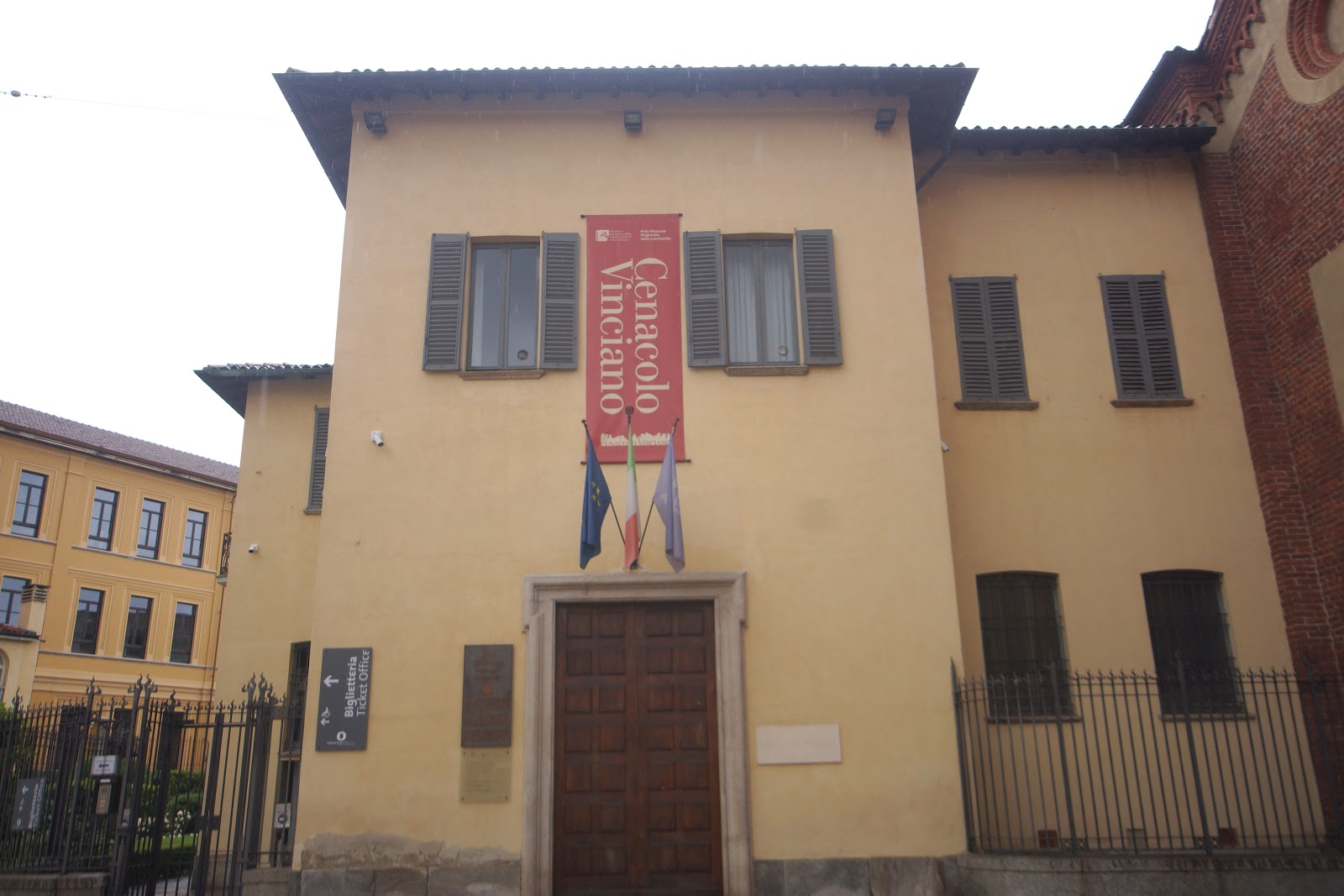
Chiesa di Santa Maria delle Grazie


Commissioned initially by Count Gasparo Vimercati and founded in 1463, the Church of Santa Maria delle Grazie saw further renovations under patron Ludovico 'il Moro' Sforza until the turn of the 15th century. Il Moro intended the Church to serve as a burial place for his family, and spared no cost on construction or ornament and in 1494, he retained the genius of Leonardo da Vinci to paint his masterpiece "the Last Supper" on the wall of dining hall in the adjoining refectory. 

Travel Tip: Tickets to view the painting require an average of three months advance booking, but the church is open to visitors without appointment.

Main Architects: Guiniforte Solari and Donato Bramante


Chiostro delle Rane (Cloister of Frogs) garden and fountain


The Church Refectory houses Leonardo da Vinci's Last Supper (1498)


Sforza Castle


The Visconti family began construction of what is now known as the Sforza Castle in the mid-14th century, but Francesco Sforza came to power in 1450 after a three year period known as the Ambrosian Republic and made the fortified construction his family's primary residence. For the next 50 years, the Sforza Dukes of Milan commissioned many of the greatest architects and artists of the Renaissance (Filarete, Leonardo da Vinci, Bramante) to make the grandeur of the Sforza palace rival that of the Medici and Pazzi in Florence and the Orsini in Rome.
Today the castle grounds and gardens are open to the public and access to the Sforza rooms and museums requires a ticket. Museums include Egyptian artifacts, medieval sculpture, musical instruments, furnishings, Leonardo's Sala delle Asse, and Michelangelo's famous final sculpture - the Rondanini Pieta.

Travel Tip: The museum offers free entry after 2PM on each first and third Tuesday of every month


Santo Spirito Tower and Battlements

The Filarete Tower and Fountain

North portico drawbridge

The Filarete Tower, Saint Ambrose (sculpted by Luigi Secchi) between Sforza Coats of Arms


Inside the castle walls, battlements and towers

Burial relief, Museum of Ancient Art, Sforza Castle

The Trivolzio Tapestries: On exhibit in the Ancient Art Museum

The Rondanini Pieta, Michelangelo's last sculpture, c.1564

Rocchetta Courtyard - 15th century

San Sepolcro - Church and Piazza


Chiesa di San Sepolcro - Initially founded in the year 1030 as the Holy Trinity,
the Church took the name Sepolcro (Sepulchre) after the 1099 Crusade to Jerusalem

Commissioned by Archbishop Saint Carlo Borromeo,
much of San Sepolcro's baroque interior was designed by Francesco Maria Richini in the 17th century

The Ambrosian Library façade from the Piazza San Sepolcro

Pinocoteca Ambrosiana façade from Piazza Pio XI founded 1607 by Federico Borromeo

Ruins long buried, the Piazza San Sepolocro was the site of the Roman forum when Milan was known as Mediolanum

In 1919, Benito Mussolini founded the Italian Fascist Party at a rally in the Piazza. 
Rally participants were known as Sansepolcristi, and the early movement was known as Sansepolcrismo

Mussolini gave a famous speech in 1936 from this Palazzo Castani e Torre Littoria balcony, see photo here. 

Around the City


Palazzo delle Borse, Milan's Stock Exchange built 1932 Architect: Paolo Mezzanotte
A sculpture of a middle finger- a gesture of ill will toward capitalism- by Maurizio Cattelan
 was meant to be a temporary fixture in the Piazza Affari but remains since 2010.


Banca d'Italia


Beautiful apartments in the area around the Sforza Castle

Gorgeous tree lined streets and Milan's above ground train system

Chiesa di San Guiseppe, 1630, a Francisco Maria Richini Baroque masterpiece

Chiesa di San Giorgio a Palazzo (750 AD) Façade architect: Francesco Croce 1774

Milan's famous opera and ballet house, Teatro alla Scala
Commissioned by Habsburg Empress Maria Theresa
Opened in 1778 to Salieri's Europa Riconoscuita

Galleria di Vittorio Emanuele II
A beautiful arcade enclosed by glass and iron, a vision of architect Giuseppe Mengoni, Completed 1867 

Piazza del Duomo

Chiesa di San Babila, consecrated approx. 1095

Amorino Gelateria in the quaint Brera district

Tables aligning the Via Fiori Chiari in the Brera district

Pinacoteca di Brera


Founded in 1776 by Austrian Habsburg Empress Maria Theresa, the Academy di Brera opened its art gallery, or Pinocoteca, in 1806 under Napoleonic rule. The gallery houses some of Europe's greatest works from the Gothics to Renaissance Masters to Picasso.

Travel Tip: The Gallery is closed on Monday. many of Milan's other galleries follow the same schedule and are open Tuesday-Sunday

Entrance to the Pinocoteca di Brera

Pinacoteca Courtyard, designed by Francesco Maria Richini, the architect of San 

Andrea Mantegna - Lamentation over the Dead Christ - 1483

Correggio - Adoration of the Magi - 1518

Caravaggio - Supper at Erasmus - 1606

Canaletto - View of the Grand Canal - 1745

Francesco Hayez - The Kiss - 1859